Human Organ
Human Organ is piece that explores the art of notation and scoring along with instrument building as a compositional practice. The piece is performed by six instrumentalists, who each play a unique instrument built especially for them. The seventh performer plays a special instrument which uses a valve-casing from a trumpet and garden hoses to inflate and deflate six balloons that are placed in front of the other performers. The performers then have to interpret the size of the balloons into different parameters, such as dynamics, pitch, rhythm etc. The seven performers thus become one entity; the Human Organ. A living, breathing instrument.
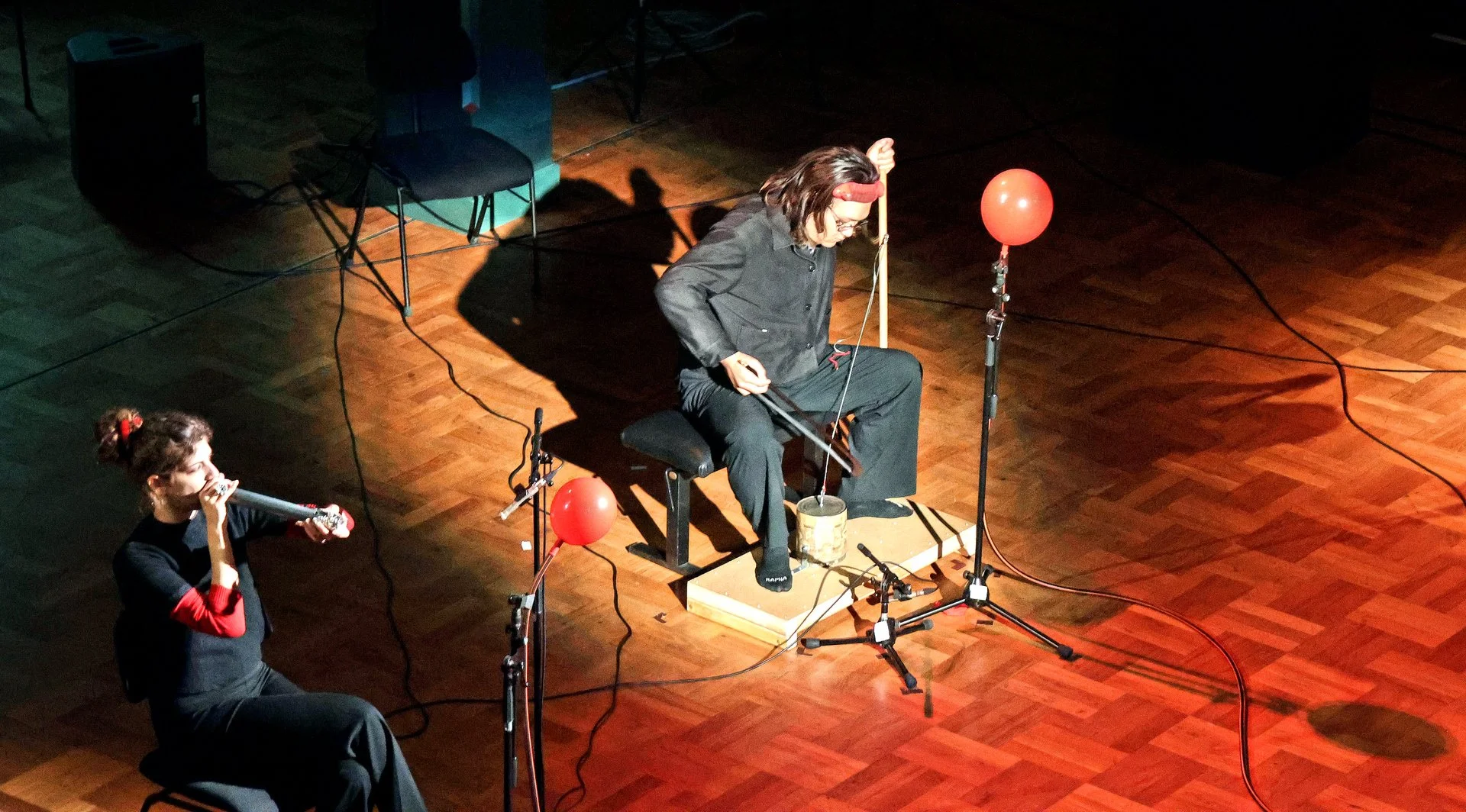
Photo by Co Broerse
Study for Extended Trumpet and Tape
Study for Extended Trumpet and Tape is a piece that came out of collaboration with trumpet player, Arthur Kerklaan and Het Muziek. It is a piece that requires the trumpet player to swap out the main tuning slide for a new tube that doubles the length of the instrument. That results in an instrument that has a different air resistance, an octave lower overtone series and micro-tonal valves. All these factors force the player to rediscover their instrument. A rediscovery that the composer hopes to result in new and more vulnerable expression.
The score for this piece is in two parts. Firstly a conventional notation with notes on staffs, but engraved in a proportional manner, so that every system of the score occupies 15 seconds. Secondly, a fixed tape is played through a sound-system that to the audience is merely ment to give contrast to the trumpet, but to the trumpet player, the tape is hiding cues that tell the player how far the piece has progressed.
Púls/Púsl vol. 2
Púls/Púsl vol. 2 is a piece for Flute, Oboe, Soprano Saxophone, Percussion, Violin, Viola and Double Bass. The piece is a game and the ensemble has to work together to try and win the game. The game has eight levels that are in theory winnable but since every level is harder than the previous one, that is highly unlikely. The way to win the game is to play on time.
The notation of the piece is an interactive score that is projected on a screen so that both performers and audience can see it. The performers have an in-ear device, through which they listen to a click-track that they must follow at all times. Every 40 clicks the timing of the ensemble is measured with a microphone. After every measurement the ensemble will be graded on how well they did, but they will also be punished. The measurement influences the stability of the in-ear metronome. If the timing difference between the ensemble and the metronome is small, the metronome’s instability will also be small.
This creates a feedback loop, the instability of the metronome makes it so that it is harder to keep time and therefore the performers are likely to make mistakes, which then results in an even more instable metronome. On top of that every level is harder than the one before because the punishment for not being on time gets harsher every time. For every level the measured time difference gets multiplied by a greater value.
Twin Whistle
Twin whistle is a piece composed in collaboration with Paul J.W. Schauenburg for the duo project Spɪtl̥iŋk. It is a piece for two players and is written for an instrument called the twin whistle. It consists of two tin whistles that are connected to each other, tail to tail via a 50 cm electrical tube. This means that when both players close all holes, the whistle becomes one resonant body to which both players contribute equally to the resulting sound.
The piece starts out with both players in the lowest register but always with at least one hole open. This phase is focused on creating interesting difference tones and in-ear harmonics with the performers playing close intervals, matching in unison and then diverging again. This is continued for some time with a general trend upwards in register until the players reach the highest notes possible on the whistle.
Then there is a sudden drop in intensity with the players closing all holes and exploring the sonic world and harmonic possibilities of the whistle.
Weather Report
Weather report is a piece for any number of players and any combination of instruments. The piece is an interpretation or Sonification of weather data. First the players select a time period to interpret, this can be the same period for every player or not, Then every player picks a place to represent. Any place and any time can be selected so long as there exists adequate weather data for the performance of the piece.
Four parameters are interpreted; time of sunrise and sunset, temperature, wind speed and rainfall. In the case of temperature and wind speed the average value over the whole 24 hours should be interpreted and in the case of rainfall the total collection of rain over the entire 24 hours should be interpreted. Optionally players can choose to interpret the direction of wind into which way they turn.
For this piece, any number of days from any time and any place can be interpreted. The piece can be used to compare different places at the same time or the same place at different times, in which case it can serve as an observation of climate change. It can also be performed by a solo player, becoming an observation of single place, without context. It can be performed with all players in the same venue, or not, in the same city or not, in the same country or not, etc.
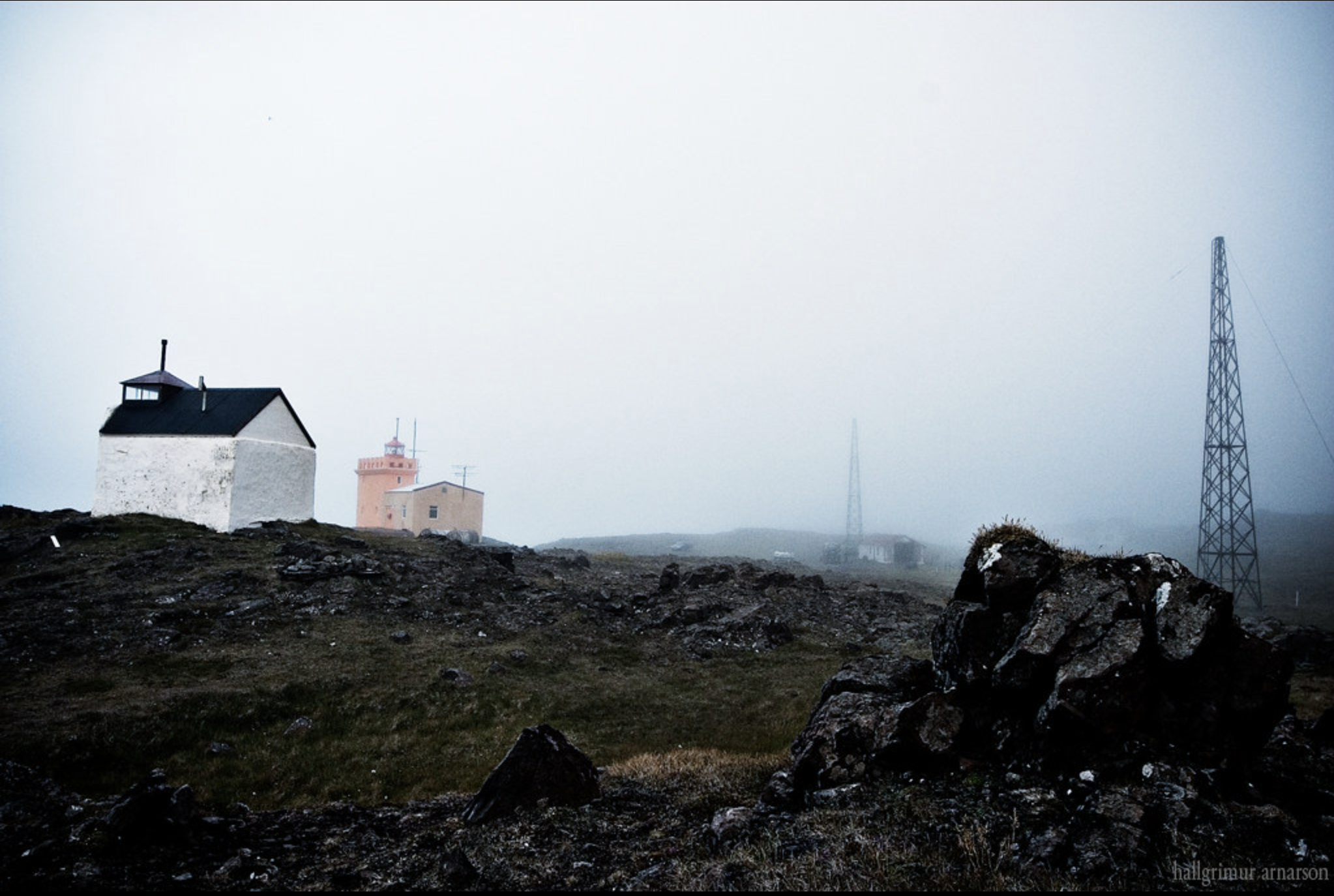
Photo by Hallgrímur Arnarson
Gifting
Gifting is a collection of four pieces composed for the occasion of the wedding of the composer and the poet Birgitta Björg Guðmarsdóttir.
Timestamps
0:34:00 - Spírall
0:46:00 - Blindsaumur
1:00:00 - Ballarbyxn
1:28:00 - Mandla